Hot Topics from CoCreate by Alibaba.com
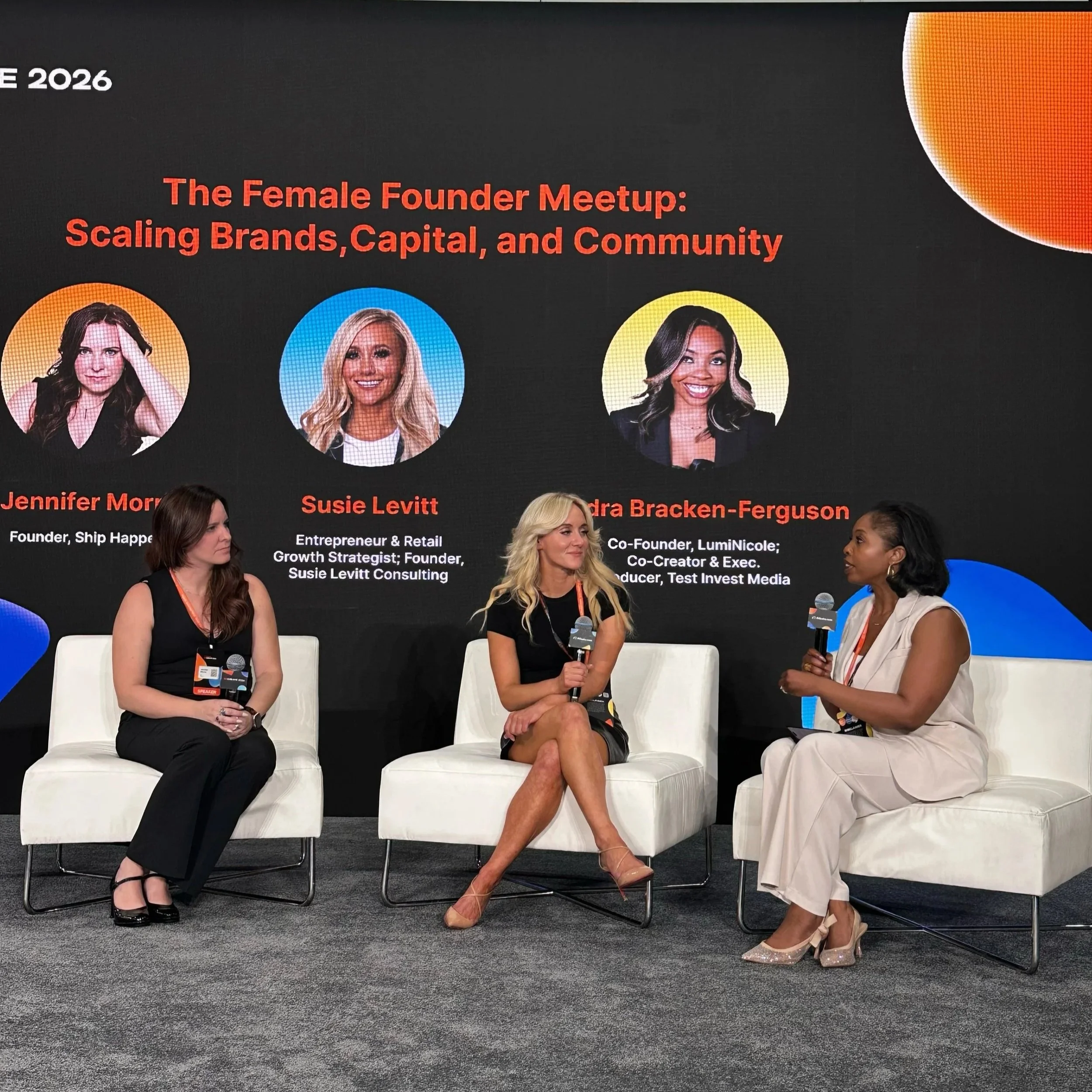
Last week I had the privilege of attending my second CoCreate by Alibaba.com, and this time I was invited to be on a panel called "The Female Founder Meetup: Scaling Brands, Capital, and Community." Thank you to everyone who came out, because I might be biased, but we had a sharp, engaged audience that made the whole thing better than I ever thought it could be.
During my two days of hallway chats, coffee meet-ups, and after-panel discussions, I noticed the same topics kept coming up. So here are the eleven hottest topics.
1. Knowing when to scale
Knowing when or if to scale is one of the most underrated decisions a growing business can make. The hesitation is often that scaling too soon or too fast can hurt you just as much as not scaling at all. Ideally you want a clear neon sign that says it's time, and it's rarely that explicit. The trap I see most often is scaling for the wrong reason. Maybe a competitor launched a new line, maybe an investor is leaning on you, or maybe a good month just felt like a trend. Then before you know it, hiring, inventory, and other costs all balloon against demand that wasn't actually consistent. And based on some of the serial founders I spoke to, the honest takeaway is that when to scale is less a moment in time and more a set of boring signals you find in your data.
2. Funding for women
On a panel literally named Scaling Brands, Capital, and Community, this was of course going to come up. Unfortunately, women founders only pull in roughly 2% of all venture capital, a figure that has barely moved in decades. And that's crazy, because women-founded companies generate around 78 cents of revenue for every dollar raised compared to 31 cents for all-male teams, which means the money is given based on something other than factual results. This 2% stat is why so many women founders bootstrap for longer, stay smaller longer than they actually want to, and get told the fix is to be more confident in the pitch.
3. Tariffs
Tariffs, unfortunately, are now as inconsistent as the weather, and founders have to find ways to deal with the uncertainty. The problem is that planning around numbers that are constantly in flux makes running a startup, a small business, or even a seasoned business stressful and unpredictable. Two things that do not help when building a business. Tariffs are unavoidable, and raw goods cannot be produced everywhere, so many are resorting to contingency plans in the event that their first-choice suppliers fall victim to tariff whims. But not everyone has the luxury to keep several vendors in different countries. So more and more founders are looking for creative ways to plan for the volatility. If you want a basic rundown of tariffs, you can learn more here.
4. Shipping costs
It's great if you have an amazing product, but if you can't get that product into your customers' hands in an efficient and economical way, you don't have a business. And the freight cost whiplash we have been seeing is directly tied to tariffs and geopolitics, two things founders have no control over. Tariffs affect ocean rates because many importers will front-load cargo ahead of threatened tariffs, causing a surge in demand and spiking rates. Then you have diesel prices soaring, so many couriers and delivery companies are adding surcharges for the last mile. Freight is one of the biggest line items you have the least control over, and building for flexibility is non-negotiable at this point.
5. AI, and how to actually apply it
AI is inevitably going to be part of almost any founder conversation, but this year the conversation was less about the tech itself and more about how and when to use it to make your business more efficient and profitable. And let's be honest, AI demos always look more impressive and magical than they do when you're in the driver's seat day to day. So far it seems the people getting real value weren't trying to hand the whole business over to AI all at once. They'd picked one annoying, repetitive task that was eating their evenings, drafting product listings, writing first-pass replies to the same ten customer questions, sorting a chaotic inbox, doing the boring first lap of sourcing research, and let the tool take that one thing off their plate. What they were not doing was using AI where it didn't make sense, where their founder judgement or genius was needed. Balance is the key to implementing AI in a way that makes businesses more effective and profitable.
6. Accio's announcements
Accio, Alibaba.com's AI agent platform for commerce, of course, was also a major topic, especially since there were several announcements. Alibaba.com ran a benchmark on real commerce tasks and Accio came in at less than half the price of the big general-purpose AI agents, with comparable quality, which, for a small team watching every dollar, matters. They also rolled out an expanded Accio that pulls research, sourcing, and the daily running of a store into one workspace, which is the part most small operators will feel day to day. As Alibaba.com president Kuo Zhang put it, for small businesses "unaffordable AI is useless." Straight facts.
7. Hiring the right people
Every founder underestimates this until a single wrong hire has cost them three months, a chunk of cash they didn't have spare, and the energy of cleaning up after someone who was never right to begin with. Often the pattern is hiring in a panic, waiting until they're already drowning and then grabbing the first person who could start Monday, which is the worst possible headspace to make this kind of choice in. The real advice is to hire slow and fire fast, something I mentioned on my panel and heard on several others as well. The truth is that most of us learned this the expensive way, so learn from our mistakes.
8. Finding mentors
Most of us are out here trying to figure this out with nobody to call when it gets strange and confusing. A mentor is the one who will challenge you, hold you accountable, and encourage you, not a blind cheerleader. And surprisingly, the best mentorships rarely come from a formal program with a matching form and a monthly calendar invite, they come from relationships that build slowly because someone showed up wanting to grow and willing to put in the work. The takeaway isn't to collect mentors like Pokémon, it's to be the kind of person worth mentoring, and to be generous to those behind you so the whole thing keeps paying forward.
9. TikTok Shop and TikTok Live Shop
TikTok Shop is on track for something like twenty-three billion dollars in US sales this year and it's the fastest-growing lane in social commerce by far, so the opportunity is very real. And Live Shop is very interesting and effective because a host demoing a product and answering questions in real time collapses the distance between wanting something and buying it down to about fifteen seconds. The catch is that it is starting to get saturated, so the question becomes how to stand out, gain market share, and get eyeballs. It really works for products that show well and sell on impulse, beauty, fashion, jewellery, food, home goods, the things people buy with their eyes, and it underperforms badly for anything technical or B2B, which makes perfect sense. So it's worth it, but only if your product fits and you're willing to treat the content like the actual job it is.
10. IP
IP came up again and again, almost always from someone who'd been copied. And this hit home for me as I'm currently fighting to trademark my brand. The biggest thing to remember is that once you have a trademark or patent, there is no one policing the internet for you. Should you be copied or duped, you have to decide whether the fight is worth the time and legal fees (which are not cheap, I promise you). The practical version of the conversation is that you WILL be duplicated, and there is no way around that. And while protecting your brand is important, sometimes the better move is to make sure you have your customer service locked in and a great marketing strategy.
11. PPWR
PPWR is the EU's new packaging law. The reason it caught a few folks off guard at CoCreate is that it's already live, the main provisions started applying in August, and because it's a regulation it lands as the same set of rules across the entire EU. It applies to anyone placing packaging on the EU market regardless of size or where you're sending from. And your packaging has to be registered in every country you ship into, separately. Which is a lot of paperwork and fees. So what are the obligations? Limits on heavy metals and PFAS in certain packaging, rules on how much empty space parcels are allowed to carry, and of course minimum levels of recyclability, recycled content, and reuse targets in later phases. So packaging that doesn't comply simply can't be sent into the EU. This will get its own post because it deserves a lot more than a paragraph, but if Europe is any part of your market, this is an action item to add to your list.
So what do you actually do with all of that
The thing is, being a founder is not easy. These are just a few of the concerns and topics, but there are so many more. Which is the whole reason CoCreate is worth showing up for, because it's one of the few rooms where you can make the connections that can give you some guidance, a contact, or an introduction to help you along in your founder journey. I'll be digging into a few of these properly over the next few weeks, so keep an eye out for those posts!