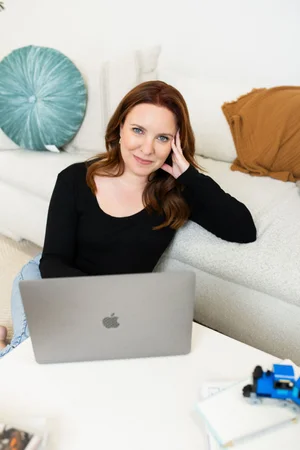
Welcome to our series celebrating the incredible women in Supply Chain and Logistics! In a traditionally male-dominated field, it's important to shine a light on the inspiring women who are making a significant impact. Through a mix of insightful and fun questions, we’ll explore their journeys, challenges, and successes. While we acknowledge the contributions of everyone in this industry, this series aims to elevate the voices and stories of women who often get missed. Joanna Pachnik is our next feature.

JOANNA PACHNIK
Joanna Pachnik is the CEO of Blueclip, and she might be the only person building AI for supply chain who will also tell you, to your face, that most of it is an expensive way to be wrong faster. She got into supply chain by accident, fleeing a financial auditor job at EY she could not stand, then somehow looped back around to finance, operations, and technology all in one role. These days she builds software that drags fragmented data out of the systems it likes to hide in. She is refreshingly blunt that no amount of clever tech ever replaces a human who actually knows the business. She speaks four languages, runs on a lot of coffee and a lot of Red Bull, and tells young women not to wait until they feel ready before they speak up. And she has firm opinions about keeping your hand on the wheel.
What is your current role and company?
CEO of Blue Clip
How did you end up in the world of supply chain?
Honestly, by accident.
While I was at university, I signed an agreement with EY. They sponsored my education and international certifications, covering virtually everything, and in return I committed to joining the firm after graduation as a financial auditor.
I started the job and hated it. Unfortunately, leaving was not really an option. The agreement carried a substantial financial penalty, and paying it would have meant my parents selling their house. So instead, I found another team within EY that was willing to take me on and absorb the penalty. That move became the starting point for everything that followed.
Since then, I have changed career paths several times, worked across different countries, and gradually moved closer and closer to supply chain and technology. In many ways, I have now come full circle - bringing together finance, operations, transformation, and technology in the work I do today.
What is your favourite part of your work day?
Meeting clients and building relationships. There are so many remarkable people working in supply chain, and I discover that again every day. I love hearing about their experiences, learning how they think, and finding ways we can create something valuable together.
What is the least favourite part of your work day?
Administrative work - I hate it. That is why, within my own company, we automate as many non-value-adding tasks as possible. It is also part of our mission for our clients: help them achieve more with the resources they already have, while allowing people to focus on what they do best - creating, collaborating, negotiating, solving problems, and thinking outside the box.
What is a systemic issue in your part of the supply chain that concerns you currently?
There are many, but if I had to choose just one, it would be the lack of agility, driven in large part by fragmented data.
Most supply chains and the systems supporting them were built for predictable workflows, with exceptions treated as noise. Today, the noise is the reality - disruptions, demand shifts, shortages, and delays are part of daily operations.
At the same time, the data needed to respond is scattered across ERP, WMS, TMS, and other systems that do not naturally work together. By the time teams assemble the full picture, the situation has often already changed. We need supply chains that can continuously connect and interpret data, understand what is happening, and support action in real time.
How would you address it if you had the power, money, or influence?
I am already working to address it. This is the reason we are building software that connects data across systems and helps companies understand and respond to what is happening in real time.
This was not realistically possible in the past, but technologies such as AI and knowledge graphs have changed what we can do. They allow companies to connect fragmented information, understand relationships and dependencies across the supply chain, identify emerging problems, and recommend or take action much faster.
If I had greater resources and influence, I would accelerate the adoption of this technology - not to replace people or existing systems, but to give teams the intelligence and agility they need to make better decisions and focus on the work where human judgment matters most. Ultimately, my goal is to empower people through technology.
What is one piece of advice you have for young women entering your field?
Just do it. Supply chain is not an easy field, but it is dynamic, intellectually challenging, and full of opportunities to make a real impact. We need more women in this industry - not simply to improve representation, but because different perspectives lead to better decisions.
In the age of AI, the human qualities that women often bring to leadership - intuition, empathy, collaboration, and a strong focus on relationships - will become even more valuable. Technology can analyze and automate, but people still need to build trust, challenge assumptions, negotiate, and bring others together.
Do not wait until you feel completely ready. Be curious, speak up, build relationships, and trust that you belong in the room.
What are your top 3 podcasts? (do not have to be industry related)
Tech Talks Daily with Neil C. Hughes - I had the pleasure of being featured on the podcast, and Neil is an amazing host. He has a real talent for making complex technology accessible while keeping the conversations practical and human.
Masters of Scale - I enjoy hearing the honest stories behind building and scaling companies, including the decisions, setbacks, and lessons that rarely appear in polished success stories.
The Diary of a CEO - I like the range and depth of the conversations. It goes beyond business and explores leadership, psychology, relationships, resilience, and what drives people.
Who are your top 5 women in supply chain to follow on LinkedIn?
Sheri Hinish - Sheri and I are both EY alumni, and I value how she brings together supply chain, sustainability, innovation, and AI while never losing sight of the human dimension. She is also a powerful advocate for women in the industry.
Lora Cecere - I do not always agree with Lora - in fact, we often have very different perspectives - but that is precisely why I enjoy reading her work. She challenges conventional thinking and forces me to test my own assumptions.
Kunthearath Nhek-Morrissey - I love Kunthearath’s people-centered perspective on supply chain, sustainability, and leadership. She combines extensive operational experience with systems thinking, entrepreneurship, and genuine compassion.
Julie Brignac - Julie brings decades of experience across procurement, supply chain, consulting, and transformation. I particularly value her emphasis on relationships, mentoring, and elevating procurement beyond cost savings to become a true strategic partner.
Marcia Williams - Marcia makes complex supply-chain planning concepts practical and accessible. I particularly enjoy her visual explanations of calculations, forecasting, inventory, S&OP, and Excel tools that practitioners can apply immediately.
How do you deal with creeps you encounter in your work day?
I take ownership of the situation and deal with it decisively. I am not afraid of confrontation, risk, or making a difficult call. When someone crosses a line, I trust my instincts, set a clear boundary, and decide whether to disengage or escalate. I would rather make a decision, take responsibility for it, and adjust if necessary than remain in limbo while unacceptable behaviour continues.
What is your favourite way to unwind?
I do not have nearly as much time to unwind as I would like, but when I do, I love hiking, cycling, and playing the piano. They allow me to step away from work, clear my head, and focus on something completely different for a while.
What have you recently changed your mind about?
I have recently changed my mind about how value is created, particularly in service businesses. I used to think value was primarily linked to people’s time, expertise, and the quality of their advice. Those things still matter, but they are no longer enough.
Real value comes from owning the outcome - not simply delivering an analysis, recommendation, or strategy and leaving the client to implement it. Technology and AI now allow service businesses to remain connected to execution, continuously monitor results, and help ensure that the promised value is actually delivered. The future of services is not about selling hours or reports; it is about combining human expertise with technology and taking accountability for measurable outcomes.
Must haves to get you thru the day?
Coffee
Redbull
Coffee
Redbull
ChatGPT
Social media for Joanna: